
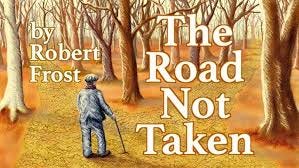
“The Road Not Taken”
There is a lot to be admired about taking the road less traveled.

Beyond The Map Treasure is a reader-supported publication. To receive new posts and support my work, consider becoming a free or paid subscriber.
📖 The Poem: “The Road Not Taken” (1916)
Written by Robert Frost.
Most people interpret it as:
Choose the unconventional path.
But here’s the twist:
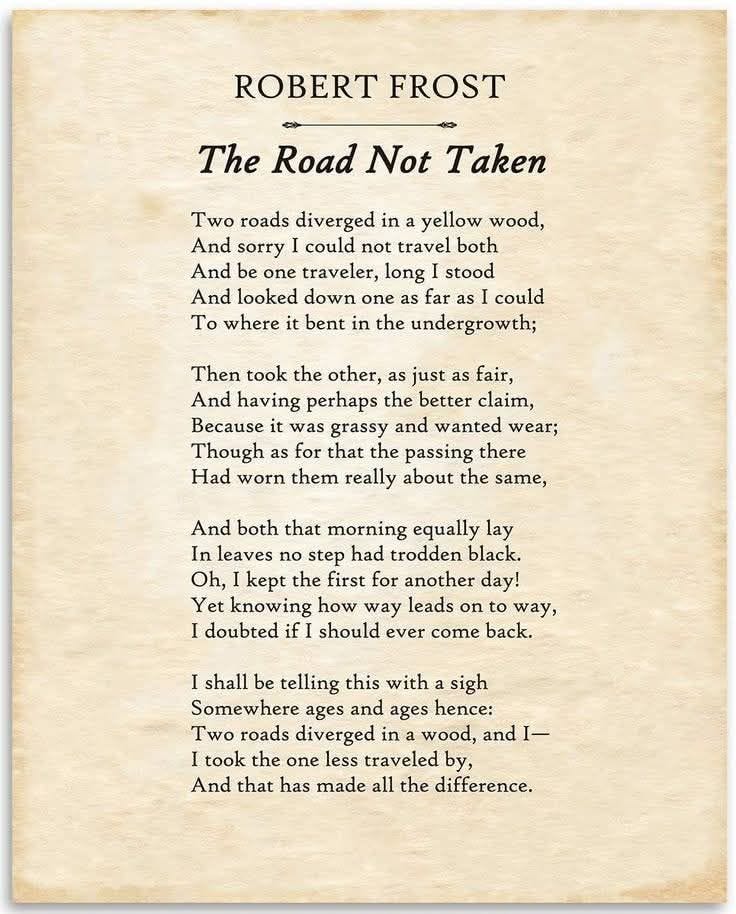
The poem actually says the two roads were:
“Really about the same.”
Frost wrote it partly as gentle satire about over-romanticizing decisions.
That’s important.
🔥 Here’s the Deeper Frost Twist
Because the roads were “really about the same,” some interpreters believe Frost was implying:
The difference is perspective, not path.
In treasure terms:
The correct solution may look ordinary.
The “less traveled” path may not actually look dramatic.
It may be subtle and easily dismissed.
The poem begins:
“Two roads diverged in a yellow wood…”
Yellow:
Fall foliage
Aspen trees
Birch forests
Gold
Autumn
If your hunt mentions gold, yellow, fall, woods — that connection might be layered.
Not the Obvious Choice
It may mean:
Don’t follow the most popular theory.
Avoid the famous landmark.
Look near the secondary feature.
The answer isn’t the big tourist attraction.
In 1894, Frost sold his first poem, "My Butterfly. An Elegy" (published in the November 8, 1894, edition of The Independent of New York) for $15 ($545 today).
My Butterfly
Thine emulous fond flowers are dead, too,
And the daft sun-assaulter, he
That frightened thee so oft, is fled or dead:
Save only me
(Nor is it sad to thee!)
Save only me
There is none left to mourn thee in the fields.
The gray grass is scarce dappled with the snow;
Its two banks have not shut upon the river;
But it is long ago—
It seems forever—
Since first I saw thee glance,
With all thy dazzling other ones,
In airy dalliance,
Precipitate in love,
Tossed, tangled, whirled and whirled above,
Like a limp rose-wreath in a fairy dance.
When that was, the soft mist
Of my regret hung not on all the land,
And I was glad for thee,
And glad for me, I wist.
Thou didst not know, who tottered, wandering on high,
That fate had made thee for the pleasure of the wind,
With those great careless wings,
Nor yet did I.
And there were other things:
It seemed God let thee flutter from his gentle clasp:
Then fearful he had let thee win
Too far beyond him to be gathered in,
Santched thee, o’ereager, with ungentle gasp.
Ah! I remember me
How once conspiracy was rife
Against my life—
The languor of it and the dreaming fond;
Surging, the grasses dizzied me of thought,
The breeze three odors brought,
And a gem-flower waved in a wand!
Then when I was distraught
And could not speak,
Sidelong, full on my cheek,
What should that reckless zephyr fling
But the wild touch of thy dye-dusty wing!
I found that wing broken today!
For thou art dead, I said,
And the strange birds say.
I found it with the withered leaves
Under the eaves.